終助詞 Case Study 1: よ, ね, よね, んだ
Introduction #
Sentence ending particles (終助詞) are extremely common in Japanese. Yet, Japanese learners, including a lot of experienced people, struggle to use them correctly. I believe it’s due to the lack of resources that actually explain when to use which, plus that fact they function at such an abstract level it’s often difficult to even verbalize their meanings. I believe it’s best to learn them through examples so I’m going to give you examples with context and explain how changing SEPs affect the meaning in this series.
Case Study #
This is an early scene from 怪獣8号 where 徳 (the tallest guy) introduces レノ, a new employee, to カフカ and then tells レノ that カフカ used to strive to join 防衛隊.
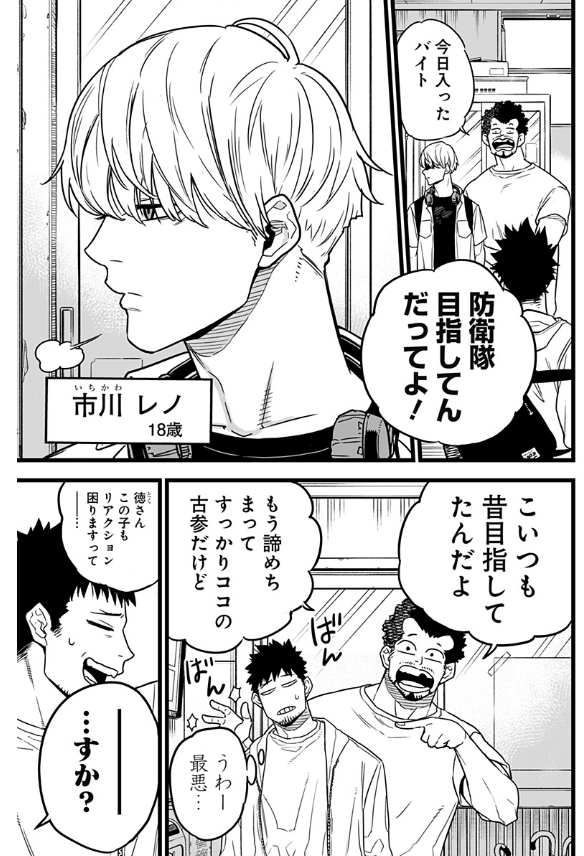
Source: 怪獣8号, Chapter 1.
We’re going to focus on this sentence:
こいつも昔目指してたんだよ
Here, んだよ shows 徳 is giving レノ new information that he thinks レノ doesn’t know (よ) and also may find surprising (んだ).
How would changing the SEPs affect the meaning?
- こいつも昔目指してたよ: This would fit because it still shows he thinks the listener doesn’t know it. But it feels less surprising without んだ.
- こいつも昔目指してた{ね/よね}: These wouldn’t make sense because they’d imply the listener already knows it.
- こいつも昔目指してたんだね: This wouldn’t fit because it implies the speaker just learned Kafuka used to try to join 防衛隊.
- こいつも昔めざしてたんだよね: This would fit perfectly and only make a small difference from the original because んだよね is sort of a softer んだよ.
Quiz 1 #
A: ねえ、明日空いてる? (Hey, are you free tomorrow?)
B: ごめん、海水浴に行く予定__。 (I’m going to go swimming in the sea.)
- だよ:
Correct
- なんだよ:
Correct
- だね:
Correct
- なんだね:
Incorrect
- だよね:
Incorrect
- なんだよね:
Correct
Quiz 2 #
Husband: あーなんか体動かしたいなあ。明日海水浴行こっか? (Mmm, I think I want to get some exercise. Why don’t we go swimming tomorrow?)
Wife: いや、明日は映画見に行く予定__。 (We’re going to see a movie tomorrow.)
- だよ:
Correct
- なんだよ:
Correct (Implies A thinks B doesn't know about the plan)
- だね:
Correct
- なんだね:
Incorrect (Though some people do use this in this kind of context)
- だよね:
Correct (Implies A thinks B should already know about the plan, and A is letting B notice their mistake or explain)
- なんだよね:
Correct (Implies A thinks B doesn't know about the plan)